
DORA resilience testing: how to prove it, not just plan it
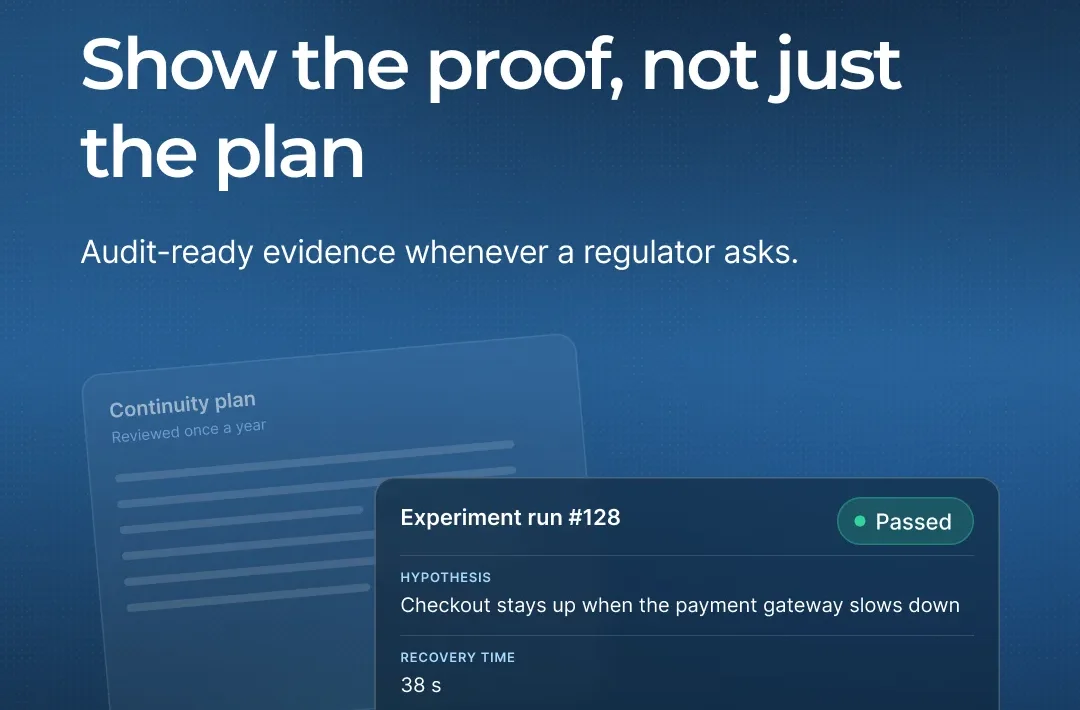
Show your regulator the proof, not just the plan
In 2025, EU financial institutions reported 3,383 major ICT incidents. Only 10% were cyber-related. Half were caused by system failures, and almost a third started at a third-party provider.
Those numbers come from the European Supervisory Authorities’ report on major ICT incidents, published in June 2026. They tell a simple story: most of what takes down a bank, insurer or trading platform isn’t an attacker. It’s a database that doesn’t fail over, a data centre that goes dark, or a payment gateway that slows to a crawl.
The Digital Operational Resilience Act (DORA) has been in effect since January 2025, and it requires you to test for all of it. More importantly, it expects you to prove that you did. This post covers what DORA asks for, why a once-a-year exercise struggles to meet it, and how to turn your resilience scenarios into evidence you can hand to an auditor.
What DORA actually asks for
DORA’s testing rules appear in a few places: the regulation itself and the technical standards on ICT risk management that underlie it. In plain English, they come down to four things.
| Requirement | What it means for you | Where it comes from |
| Test critical systems every year | Every ICT system and application that supports a critical or important function needs appropriate tests at least once a year. | DORA Article 24 |
| Prove your continuity plans work | Test ICT business continuity and response and recovery plans at least yearly, and after any substantive change to your systems. | DORA Article 11 |
| Use severe but plausible scenarios | Include switchover from primary infrastructure to redundant capacity, and consider the failure of ICT third-party providers. | RTS (EU) 2024/1774, Article 25 |
| Keep and act on the evidence | Document the results, analyse and fix deficiencies, and report them to the management body. | RTS (EU) 2024/1774, Article 25 |
DORA’s list of acceptable tests is broad. Alongside vulnerability scans and penetration tests, Article 25 names scenario-based tests, performance testing and end-to-end testing. That’s exactly the territory of reliability and chaos experiments.
Once-a-year exercise isn’t enough
“At least yearly” is a minimum, not a target. Three things make a single annual test hard to defend.
- Your systems change every week. DORA asks you to retest continuity plans after any substantive change. In a world of continuous delivery, that’s most weeks. A test from March says little about the system you’re running in November.
- Realistic tests go out of date. A test is only realistic for the system as it was on the day you ran it. Testing real systems is also only safe in small, controlled steps, which is ea
- Your suppliers change without telling you. Third parties update their systems on their own schedule, so your own change calendar won’t flag it. The only way to know your fallbacks still work is to keep testing them.
The answer isn’t to run a bigger exercise once a year. It’s to make resilience testing small, safe and repeatable enough to run all the time.
Turning DORA scenarios into repeatable experiments
Most financial institutions already have a list of disruption scenarios, often written by the business continuity team. The step that’s missing is turning each one into an experiment you can run against real systems, safely and on demand.
| DORA scenario | What the experiment does |
| Availability zone, data centre or region loss | Takes a zone or site out of service and checks that traffic fails over and recovers within your targets |
| Switchover to redundant capacity | Fails the primary database or service and measures how long the switch to the standby takes |
| Third-party provider failure | Makes a payment gateway, market data feed or SaaS API fail or slow down, and checks timeouts, retries and circuit breakers |
| Network disruption | Adds latency, packet loss or a full outage between services |
| Capacity exhaustion | Pushes CPU, memory or load until something gives, and checks that scaling and degradation behave as planned |
Running these on real systems only works if it’s safe. With Steadybit, every experiment has limits on how much it can affect, automatic stop conditions tied to your monitoring, and an emergency stop. That lets you move beyond tabletop exercises without putting customers at risk.
Because each scenario is a saved experiment, you can schedule it, run it in your CI/CD pipeline so a failing check stops a release, and rerun the exact same test to prove that a fix worked.
What audit-ready evidence looks like
DORA asks you to document test results and act on what they show. In practice, an auditor or supervisor wants to see, for each test:
- What you tested and why: the system, the scenario and the business function it supports.
- What you expected: the hypothesis, such as “payments keep processing if the primary database fails”.
- What actually happened: the result, with the monitoring data behind it.
- How long recovery took: measured, not estimated.
- Who did what: an audit log of who ran the test and when.
- What changed afterwards: the fix, and a rerun showing it worked.
Steadybit records all of this automatically with every run, and produces reports you can hand to your risk team, auditor or supervisor. The evidence is a by-product of the testing, not a separate documentation project.
How financial services teams are doing it
A UK online trading platform started with the DORA scenarios its business continuity team had already written: a data centre going down and coming back, critical services failing hard, a third-party broker becoming unavailable. The team is turning each one into a Steadybit experiment, with pass-or-fail results gating its CI/CD pipeline and every run kept centrally as evidence for auditors and the regulator.
A Latin American bank built in governance from the start. A small team of SRE champions tests circuit breakers and latency, while more than 100 QA engineers run experiments only within their own part of the estate. Users and teams sync from the bank’s identity provider, so access stays controlled as the rollout grows.
Both show the same pattern: resilience testing works best in a regulated business when it’s part of everyday engineering, with the controls a risk team expects.
Where to start
You don’t need to automate every DORA scenario on day one. A practical first month looks like this:
- Pick one critical or important function, such as payments or trading, and list the systems behind it.
- Take three scenarios from your continuity plan for those systems: one infrastructure failure, one failover and one third-party failure.
- Run them in a test environment first, with tight limits and automatic stop conditions.
- Review the evidence with your risk or BCM team so it matches what your auditor expects.
- Schedule the experiments or add them to your pipeline, then extend to the next function.
Want to see what this looks like on your own systems? Book a demo and we’ll walk you through it.
Sources
- European Supervisory Authorities, 2025 report on major ICT incidents (June 2026)
- Regulation (EU) 2022/2554 (DORA), Articles 11, 24 and 25
- Commission Delegated Regulation (EU) 2024/1774, Article 25

Get started today
Full access to the Steadybit Chaos Engineering platform.
Available as SaaS and On-Premises!
or sign up with

Book a Demo
Let us guide you through a personalized demo to kick-start your Chaos Engineering efforts and build more reliable systems for your business!